




Scientific Breakthrough | Separation And Purification Process For Recombinant Humanized Type II Collagen
 Aug 20, 2026|
 Type II collagen is a structural protein mainly found in cartilage tissue. It provides support and cushioning for joints and helps maintain the mechanical properties and structural integrity of cartilage. It has significant application potential in joint health care and cartilage tissue engineering.
Compared with traditional extraction methods, recombinant collagen produced through microbial host fermentation offers stable quality, good biocompatibility, and no risk of viral contamination, making it a major research focus. Recombinant humanized Type II collagen produced by fermentation using engineered *Pichia pastoris* has attracted considerable research interest. However, the high cost and complexity of separation and purification remain major challenges in establishing an efficient process for the industrial-scale production of recombinant collagen.
A research team from the School of Life Sciences and Medical Engineering at Anhui University, in collaboration with Anhui Zhongsheng Anlan Health Industry Co., Ltd., developed a complete separation and purification process for recombinant humanized Type II collagen II-23k based on Tangential Flow Filtration (TFF) combined with DEAE weak anion-exchange column chromatography in flow-through mode , providing a feasible solution for large-scale production.
Complete Industrial-Scale Purification Process
The entire process consists of four major steps:
Clarification Filtration → Concentration & Diafiltration → DEAE Column Flow-Through Chromatography → Freeze-Drying

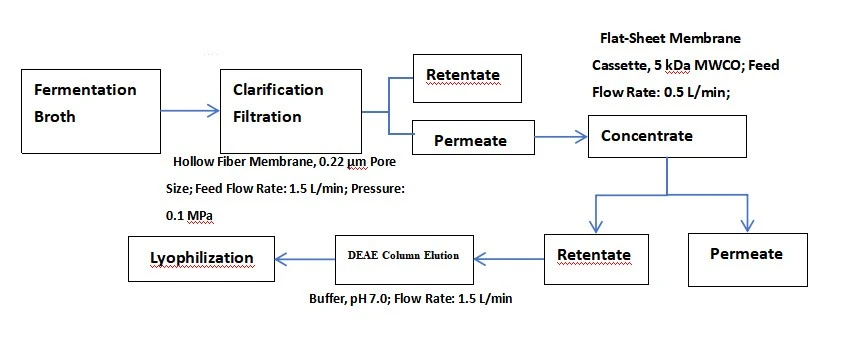
Figure 1. Separation and purification process for recombinant humanized Type II collagen II-23k
Key Process Screening
The research team compared four types of ion-exchange chromatography media: Q strong anion-exchange, DEAE weak anion-exchange, SP strong cation-exchange, and CM weak cation-exchange columns .
Among them, the DEAE weak anion-exchange column showed the best performance. Under a buffer condition of pH 7.0 , the column was operated in flow-through mode , achieving a target protein purity of >95% and a recovery rate of >90% , with no residual pigments detected.
The separation and purification processes for different recombinant collagens expressed by different microbial hosts vary considerably. In general, however, the overall strategy can be divided into primary separation and fine purification .
The purpose of primary separation is to remove solid suspended matter such as microbial cells and prepare the fermentation broth for subsequent fine purification. This stage mainly involves centrifugation and filtration. Conventional industrial centrifuges are generally large in size, expensive, and limited in rotational speed, resulting in relatively low processing efficiency. Tangential Flow Filtration (TFF) has a lower operating cost and effectively reduces membrane clogging and fouling associated with conventional dead-end filtration. Therefore, TFF has been widely applied to the clarification filtration and concentration/diafiltration of fermentation broths containing recombinant proteins.
The purpose of fine purification is to further improve product purity by removing impurities such as host-cell proteins and pigments through chromatographic techniques. Among these technologies, ion-exchange chromatography offers high resolution and strong selectivity and is widely used for the large-scale production of various biomolecules.
In industrial production, ion-exchange chromatography places relatively high requirements on sample clarification and ionic strength. Meanwhile, TFF can handle large volumes of feed material, is easy to maintain, and offers good scalability, making it widely applicable to downstream purification processes for bioproducts.
Therefore, when establishing the separation and purification process for II-23k , a 0.22 μm TFF hollow fiber membrane was used for clarification filtration of the fermentation broth to remove microbial cells and other solid impurities. A 5 kDa TFF flat-sheet membrane cassette was then used for concentration and diafiltration, completing the pretreatment prior to chromatography. Finally, DEAE column chromatography in flow-through mode was employed for purification.
The results demonstrated that the process performed effectively, achieving a final product purity of approximately 95% , with no residual pigments detected. The overall recovery rate of the complete process reached nearly 60% .
Further improvements in recovery may be achieved by increasing the feed volume and reducing the membrane cassette pressure gauge reading during the concentration and diafiltration stage. The recovery of the chromatography step can potentially be improved by lowering the chromatography operating temperature and increasing the salt ion concentration in the buffer .
Reference
Meng Zixuan, Shi Weiwei, Zhang Maifei, et al. Separation and Purification Process for Recombinant Humanized Type II Collagen . *Chinese Journal of Biology*, 2026, 43(1): 91–96.